
Near-Packaged Optics (NPO) is quickly becoming one of the most debated architectures in next-gen hyperscale interconnects. But beneath the marketing decks lies a fundamental design decision that shapes cost, serviceability, and reliability for years: where does the light come from?
The architecture itself is elegant. A 32-channel MZM PIC handling TX & RX with integrated TIAs (4ch × 8), driven by 8-channel linear drivers (×4), pushing 32 × 200 Gbps lanes through the optical connector — all orchestrated by an on-board MCU. That's 6.4T of aggregate bandwidth sitting right next to the switch ASIC.
But the laser sourcing strategy? That's where the real engineering trade-offs live:
External Laser Source (ELSFP)
✅ Decouples the light source from the module — a laser failure doesn't take down the optics
✅ Field-replaceable in minutes, no module swap needed
❌ ELSFP eats precious front-panel real estate
❌ Extra PM fiber and connectors mean higher insertion loss — and potentially higher cost
Internal Laser
✅ The NPO module can be replaced independently — no need to swap the entire ASIC motherboard
✅ Lower power consumption
✅ Potentially lower BOM cost
❌ Laser packaging complexity
❌ Laser heat dissipation and MTBF become the reliability battleground
My take: There's no universal winner. If your operations model prioritizes field serviceability and laser redundancy, external wins. If you're optimizing for power, density, and cost per bit, internal is compelling — provided you've done your thermal homework.
The industry will likely land on different answers for different deployments. What's your architecture leaning toward — and why?
👇 Drop your thoughts in the comments.
#NPO #OpticalInterconnect #CPO #DataCenter #Hyperscale #Photonics #800G #Networking #OpticsEngineering
Blog posts
-
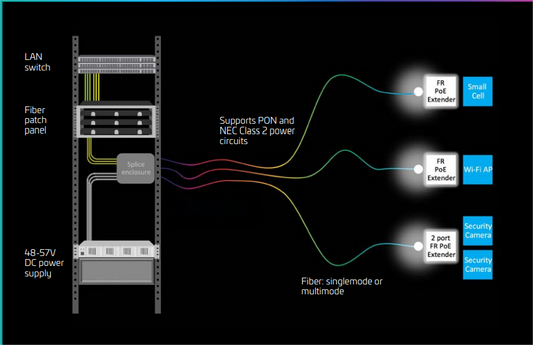
What are the applications of the Hybrid Powered...
DFT Hyrid solutions combine highperformance, low-latency fiber-optic data connectivity with a low-voltage copper direct current (DC) powerconnection. This enables the connection of poweredremote devices without the need for new conduit,bulky...
What are the applications of the Hybrid Powered...
DFT Hyrid solutions combine highperformance, low-latency fiber-optic data connectivity with a low-voltage copper direct current (DC) powerconnection. This enables the connection of poweredremote devices without the need for new conduit,bulky...
-
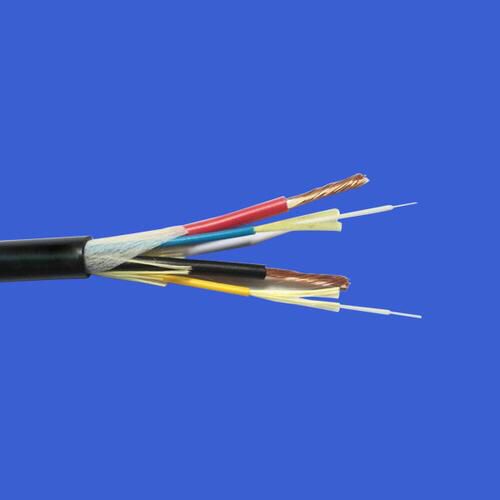
What are the applications of Optical Power Comp...
Optical Power Composite Cables, also known as光电复合缆 in Chinese, find application across diverse scenarios due to their unique integration of optical fibers and copper conductors within a single cable, enabling concurrent transmission of electrical power and data signals. Some key application areas include: 1. Telecommunication Base Station Deployment: In remote telecommunications base stations, these cables provide both power and signal transmission capabilities, streamlining base station installations and reducing deployment costs where separate power and data lines would be impractical 2. Broadband Access Networks: They are crucial for addressing the “last mile” connectivity challenge in broadband networks, delivering data services to users while also powering equipment, especially beneficial in areas where traditional power line installation is difficult or uneconomical. 3. Heavy Industrial Applications: Used in harsh environments such as ports for crane operations, rapid container handling systems, and underground mining equipment, where they ensure reliable power supply and control system connectivity under extreme conditions. 4. Data Center Interconnects: Within or between data centers, these cables facilitate high-volume data transmission while also catering to the power needs of remote or distributed devices. 5. Smart Buildings and Security Surveillance: In modern smart buildings and security surveillance systems, they are deployed for cameras and other IoT devices, enabling long-distance high-definition video transmission and device powering. 6. Transportation Infrastructure: In railway, subway lines, and highway surveillance and signaling systems, they reduce installation and maintenance costs while enhancing system reliability. 7. Emergency Communication Systems: In disaster response or other emergency situations, optical power composite cables can be rapidly deployed to provide immediate communication links and power support at rescue sites.As technology advances and new application scenarios emerge, optical power composite cables continue to be a pivotal solution for complex wiring challenges and remote power provisioning requirements.
Blog posts
View all-

What is OTN (Optical Transport Network)? | Comp...
Optical Transport Network, commonly known as OTN, is a standardized optical transport layer widely used by telecom carriers, ISPs and large data center operators. It provides reliable, high-capacity transmission for...
What is OTN (Optical Transport Network)? | Comp...
Optical Transport Network, commonly known as OTN, is a standardized optical transport layer widely used by telecom carriers, ISPs and large data center operators. It provides reliable, high-capacity transmission for...
-

Open CPX: An Open Standard Built for the Next G...
If you’ve been following the evolution of high-density optical interconnects for data centers and AI compute infrastructure, you know the big bottleneck we’re solving for right now: standardization across all...
Open CPX: An Open Standard Built for the Next G...
If you’ve been following the evolution of high-density optical interconnects for data centers and AI compute infrastructure, you know the big bottleneck we’re solving for right now: standardization across all...
-

Comparing FC, Ethernet, and InfiniBand: A Quick...
When designing modern data centers or high-performance clusters, choosing the right interconnect technology is critical. Here’s a concise breakdown of Fibre Channel (FC), Ethernet, and InfiniBand (IB) based on key...
Comparing FC, Ethernet, and InfiniBand: A Quick...
When designing modern data centers or high-performance clusters, choosing the right interconnect technology is critical. Here’s a concise breakdown of Fibre Channel (FC), Ethernet, and InfiniBand (IB) based on key...
-
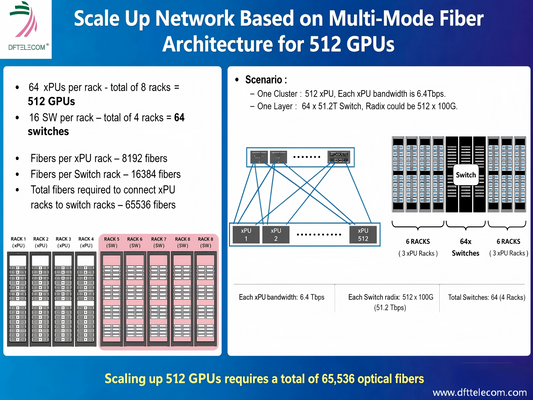
How We Size Fiber Counts for a 512-GPU Scale-Up...
If you're architecting large-scale AI HPC clusters, you know fiber infrastructure makes or breaks performance. Let's break down the fiber calculation and purpose for this 512-GPU scale-up build, step by...
How We Size Fiber Counts for a 512-GPU Scale-Up...
If you're architecting large-scale AI HPC clusters, you know fiber infrastructure makes or breaks performance. Let's break down the fiber calculation and purpose for this 512-GPU scale-up build, step by...


Blog posts
-

The Roadmap to Storage Extension in Data Center...
The Roadmap to Storage Extension in Data Center Environments In today's rapidly growing data landscape, organizations must continuously expand their storage capabilities to accommodate demands. This article will discuss...
The Roadmap to Storage Extension in Data Center...
The Roadmap to Storage Extension in Data Center Environments In today's rapidly growing data landscape, organizations must continuously expand their storage capabilities to accommodate demands. This article will discuss...
