Everyone’s talking about 1.6T like it’s just a bigger number on a datasheet. It’s not. The jump from 800G to 1.6T per port forces you to rethink the physical layer, especially if you’re building around NVIDIA’s GB200 NVL72 or similar rack-scale architectures.
Here’s the uncomfortable truth: at 1.6T, copper DACs are still viable inside the rack—but barely. The OSFP close-top passive DAC we’ve been shipping hits 1.6T with power consumption under 0.1W. That’s not a typo. For intra-rack connections where you’re not pushing past a couple meters, passive copper is still the lowest-power, lowest-latency option, and it’s what the GB200 backplane designs are leaning on. The thermal profile of a close-top OSFP housing matters more than most people realize when you’re packing that much signal density into a 1U space.
But the moment you leave the rack, optics take over. The 1.6T OSFP DR8D modules running 1311nm over dual MPO-12 single-mode fiber give you 500m to 2km reach depending on the variant. What’s interesting isn’t the reach—it’s the breakout flexibility. A single 1.6T port can fan out to 2x800G, 4x400G, or 8x200G. That matters for AI clusters where the leaf-spine topology is asymmetric and you’re mixing GPU generations or NIC speeds across the fabric.
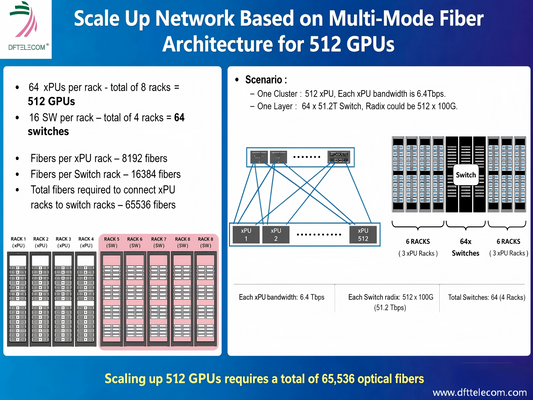
The real bottleneck people are hitting isn’t the module itself. It’s the fiber plant. If you’re still running MPO-12 trunks from the 400G era, you’re going to need MPO-16 or parallel MPO-12 pairs to terminate a 1.6T DR8D cleanly. That’s a cabling audit you should do before you order a single transceiver. We’ve seen deployments stall because the optics arrived and the fiber wasn’t polarized correctly for the new lane mapping.
One more thing: don’t assume your existing test gear handles 1.6T PRBS patterns. The BER targets at PAM4 1.6T are tight enough that a marginal scope or a dirty connector endface will send you chasing ghosts for days. Clean your MPO endfaces. Every time.
Blog Post 2: The DCI Box Is Not a Router — Stop Configuring It Like One
I keep seeing deployment tickets where someone has tried to treat a 1U DCI box like a mini core router. It’s not. The FW-8800 is a transport platform, and if you provision it with router logic, you’ll fight the hardware all day.
The architecture is straightforward once you internalize it: 4 slots in 1U, each slot takes either a 400G transponder card or a 2-channel 200G card. Fully loaded, that’s 1.6Tbps in a single rack unit—3.2Tbps bidirectional if you’re counting both directions. The client side gives you 4x100G per 400G card via QSFP28, and the line side is a single CFP2 at 400G or dual 200G. Notice what’s missing? There’s no switching fabric. No packet buffer. No routing table. This thing exists to take client signals, map them into OTN or OpenZR+ frames, and push them down a coherent line. That’s it.
Where people get into trouble is the FEC configuration. The line side supports SD-FEC, OpenROADM, and OpenZR+. If you’re interoperating with a third-party ROADM or a legacy OTN domain, do not just leave it on the default and hope for the best. OpenZR+ and OpenROADM have different overhead structures and different latency contributions. Match the FEC mode to the far end before you turn up the link. I’ve seen turn-up windows blown because someone assumed a 400G ZR+ plug would negotiate cleanly with a proprietary FEC on the other side. It won’t.
The stacking story is also worth understanding properly. The 1.6T in one box is fine for a metro aggregation point or a small DCI edge. But if you need to scale to 19.2Tbps or 25.6Tbps, you’re stacking up to twelve of these things. That’s a lot of 1U real estate and a lot of AC draw—budget roughly 800W per fully loaded chassis, and that’s before you account for the fact that dual power supplies are mandatory for anything resembling a production deployment. Plan your rack power and cooling for the stack, not the single box.
Finally, the ALS function. Turn it on. The automatic laser shutdown is there because 400G CFP2 line optics will absolutely ruin your day—and your retina—if you’re troubleshooting a fiber disconnect and the far end is still blasting. It’s not a nice-to-have.